

All you need to know about Canada Immigration Programs
Canada is in great need of immigrants to continue the excellent economic growth the country has experienced over the past few years. To keep up with the trend the country keeps increasing immigration targets to numbers over 400,000 every year.For this reason, the country has developed a highly diverse and flexible list of Canada Immigration Programs.
Canada has skills, and labour shortages in many industries across the country due to an aging population. The current worker-to-retiree ratio is 4 to 1. The solution? Temporary foreign workers help Canadian employers to meet labour needs when qualified Canadians or permanent residents aren’t available. Even more importantly, temporary workers support the success and growth of many industries, such as agriculture, healthcare, and technology. This is exactly why the Temporary Foreign Worker Program was formed.
What is the Temporary Foreign Worker Program (TFWP) ?
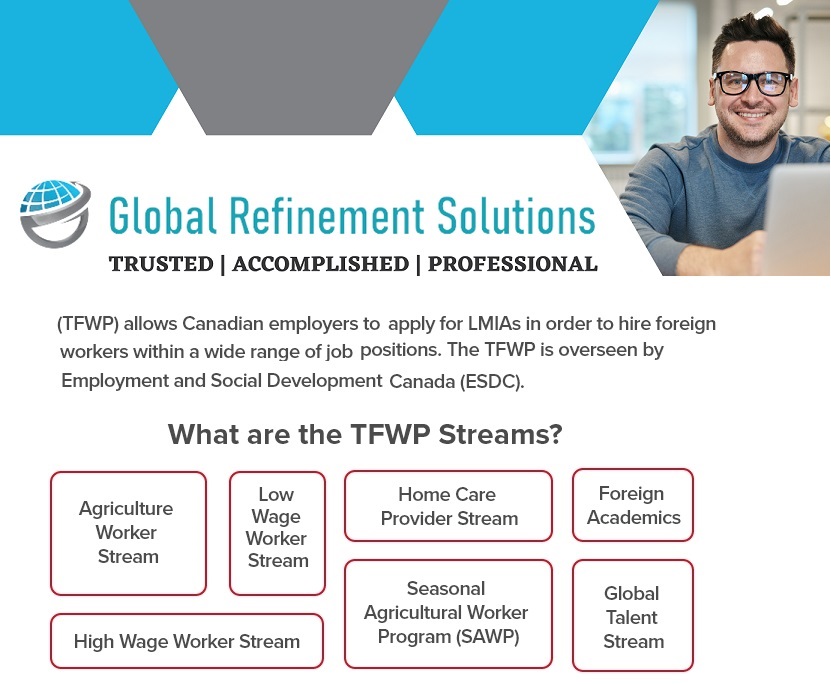
Planning to recruit from abroad? Want to work in Canada? The Temporary Foreign Worker Program (TFWP) is designed for Canadian employers to hire foreign workers within a wide range of job positions. The most important part of the TFWP hiring process is applying for a Labour Market Impact Assessment (LMIA). An LMIA proves that no Canadian or permanent resident was available to fill the job position.
Learn more about the seven different TFWP streams below.
1.High Wage Worker Stream
Employers who plan to hire a temporary foreign worker who will be paid at or above the median hourly wage of their province or territory must apply for an LMIA through the TFWP stream for high-wage workers, demonstrating that they were unable to find a Canadian citizen or permanent resident to fill the position.
2.Low Wage Worker Stream
Employers who plan to hire a temporary foreign worker who will be paid less than the median hourly wage of their province or territory must apply for an LMIA through the TFWP stream for low-wage workers, demonstrating that they were unable to find a Canadian citizen or permanent resident to fill the position.
Hiring low-wage workers requires employers to meet additional requirements to ensure the workplace rights and safety of low-wage non-resident workers. Once an employer is issued a positive LMIA for a low-wage skilled position, they must send a copy of the LMIA to the worker
3.Agriculture Worker Stream
Due to Canada’s ongoing demand for agricultural workers, especially in peak seasons, employers who need to hire workers to fill specific job positions related to agricultural production may be able to use one of two agricultural streams to accelerate the hiring process. In order to qualify for either stream, employers must ensure that their production is in a sector on Canada’s national commodity list and the activity must be related to on-farm primary agriculture in one of these National Occupational Classification codes: 0821, 0822, 8252, 8255, 8431, 8432, and 8611.
4.Seasonal Agricultural Worker Program (SAWP)
Canada has bilateral agreements with specific countries that allow employers to hire agricultural workers to work in Canada for up to eight months during peak farming periods. The foreign workers must be citizens of Mexico or one of the following Caribbean countries; Anguilla, Antigua and Barbuda, Barbados, Dominica, Grenada, Jamaica, Montserrat, St. Kitts-Nevis, St. Lucia, St. Vincent and the Grenadines, and Trinidad and Tobago. If an employer meets the requirements for the SAWP, they can apply for an LMIA and easily hire qualified workers with experience and who can meet the additional requirements of working in Canada.
5.Global Talent Stream (GTS)
The Global Talent Stream (GTS) assists eligible Canadian employers to hire highly-skilled workers under one of two categories. Category A = is for employers who have been referred to by one of the GTS designated partners and want to hire highly-specialized workers. Category B is for employers who want to hire highly-skilled workers on the GTS Occupations List. The Global Talent Stream expedites the hiring process for employers by doing away with the LMIA requirement to prove they first tried recruiting Canadians and permanent residents of Canada. Also, work permit applications for the GTS are processed in about 10 business days.
6.Home Care Provider Stream
Families who need to hire a foreign caregiver to provide care, in a private residence, to seniors or individuals with medical needs, or children, may be able to do so through the Home Care Provider Stream of the TFWP. This stream enables families to hire temporary foreign workers, provided that the positions to be filled meet one of the following criteria:
7.Caregivers for children
Nannies, au-pairs and babysitters are just some of the positions that fall under this category, and provide care to children under the age of 18 years old. The position must meet the requirements for National Occupation Classification (NOC) Code 4411.
Caregivers for persons with high medical needs:
Family caregivers, housekeepers, and personal aides are just some of the positions that fall under this category, and provide care to seniors or to persons with disabilities. The position must meet the requirements for one of NOC 3012, 3233, or 4412. Families must follow the same application procedure as employers hiring through the high-wage and low-wage streams. Additionally, families must provide evidence that they have a dependent family member who requires in-home care; and show proof that they have the financial means to pay the wages of the in-home caregiver.
8.Foreign Academics
It is in the best interest of universities, degree-granting colleges, and unions representing Canadian education to hire foreign academics. They fill in-demand positions and bring new knowledge and expertise to Canadian campuses. Employers must follow the same application procedure as employers hiring through the high-wage stream. In most cases, foreign nationals hired in research positions at post-secondary institutions may be exempt from requiring an LMIA, a work permit, or both.
What’s the next step?
Both foreign workers and Canadian employers benefit from the Temporary Foreign Worker Program (TFWP). Workers get to make the most of the incredible economic opportunities in Canada and pave the way to a permanent future in the country. At the same time, employers gain the much needed skills and labour for their businesses to get to the next level and remain competitive in the Canadian market.

Provincial Nominee Program (PNP)
Canada aims to welcome between 64,000 – 81,500 immigrants through the Provincial Nominee Programs (PNPs) in 2021. Just how many PNPs are there in Canada? There are more than 80 provincial nomination programs in Canada that allow participating provinces and territories to nominate eligible economic immigration candidates for Canadian permanent residence. Learn more about the different Provincial Nominee Program types for exciting alternative routes to Canada.
About Canada’s Provincial Nominee Programs
The Canadian government made an agreement with local provinces in which they can nominate immigrants who wish to live, settle, and work in that particular province or essentially, immigrate to Canada. In order to receive a visa through the Provincial Nominee Programs (PNP), the candidate is required to choose a province they wish to live in and subsequently apply for a nomination.
The province will then consider the application based on its immigration and labor needs, while also assessing your genuine intention to settle in the province.
For most provinces, Canadian immigration is an important part of not only boosting local economies and development in key sectors but also supporting an aging population.
11 Provincial Nomination Programs in Canada
- Alberta Immigrant Nominee Program (AINP)
- British Columbia Provincial Nominee Program (BC PNP)
- Manitoba Provincial Nominee Program (MPNP)
- New Brunswick Provincial Nominee Program (NW PNP)
- Newfoundland & Labrador Provincial Nominee Program (NL PNP)
- Northwest Territories Nominee Program (NTNP)
- Nova Scotia Provincial Nominee Program (NS PNP)
- Ontario Provincial Nominee Program (OINP)
- Prince Edward Island Provincial Nominee Program (PEI PNP)
- Saskatchewan Provincial Nominee Program (SINP)
- Yukon Nominee Program (YNP)
Note that the province of Quebec has its own unique immigration selection system and a points system that is also different from other provinces.
Study Visas and Study Permits
Students from India have two streams to apply for a study visa for Canada:
- SDS (Student Direct Stream)
- General category
SDS replaced the highly successful SPP in India in 2017. It’s a streamlined process that allows faster application processing for students from India.
Few key requirements of the SDS program are:
- IELTS 6 band in each module for undergraduate diploma/degrees
- IELTS 6.5 band in each module for Post graduate diplomas/Master’s degree.
- $10,000 GIC paid upfront before visa application.
- 100% of the college/university fees paid before visa application. There should be no outstanding amounts at all.
- The institute that the student has gained admission must have DLI number.
Our advice is that most students from India apply for their student visa in the SDS category.
All public colleges and universities have a DLI number.
The small percentage of students who can’t get admission in a public institution may attain admission in a private college and apply for a student visa through the General category.
All students who are applying in General category should pay the whole year’s tuition fee upfront and also pay for a GIC, just as in the SDS program. This greatly increases the chances of a visa.
Students from India, who are thinking of going the private college route, must still know that the approval rates for applications through the General category is very low.
Nonetheless, a well justified application has good chances in getting approved in the General category as well.